
Our Story
syne.studio a passion project developed by a couple of software and electronic music nerds, who want to make music creation more accessible and more collaborative. We have never taken outside funding, and have no plans to. We’re just trying to build the perfect DAW for us, and those like us.
Inspiration
The idea of syne.studio came to me way back in 2014. One of my favorite activities had been making music with my best friend Evan. But when the time came for us to go to college, we ended up having to move apart.
After I had gotten settled down, I started looking for ways that we could continue co-producing remotely, but I was surprised to find that none existed. There were tools that let you sync project files between computers, but this only allowed passing projects back and forth. We couldn’t replicate what we were used to: being inspired by each other in the moment and taking turns hopping in the computer chair to follow those ideas to a finished song. I just couldn’t find any way for us to have that in-the-moment musical conversation remotely.
The idea seemed simple to me: A DAW with real-time collaboration built in from the ground up. All audio generated locally without latency, but all the knobs connected between multiple remote collaborators, updating in real-time. You could even work on different parts of the track simultaneously, something that we couldn’t do with our in-person shared computer workflow. I started imagining all the unprecedented things you could do with something like this: cloud-synchronized production libraries, version control, even open-source music production, and I became obsessed. I knew that if something like this existed, we could get our collab sessions back no matter where we were.
The First Prototype
I’d already had an interest in programming since I was a teenager, so I figured this was the perfect project for me to practice with! I dove deep into web development, learning about all the technologies available to see if what I had in mind was even possible. The more I learned, the more I understood why nobody had built this yet: DAWs are incredibly complex, and when you throw in real-time collaboration (one of the hardest problems in distributed computing) and working in the browser, the technical challenge turned out to be pretty extreme.
Nevertheless, I threw myself at the problem with all the boundless optimism of my early 20s. I just started trying to build things one at a time, rewriting when I hit some limitation I wasn’t aware of. I kept iterating on and off alongside my college work, and by 2017 I got the initial prototype up on the web. It was super basic, but I was excited and proud that I had something running that I could show people. It supported audio & MIDI arrangement and recording, a couple of audio effects and a basic synthesizer. It supported real-time collaboration too, although only in theory since there was no way to invite people to your projects yet.
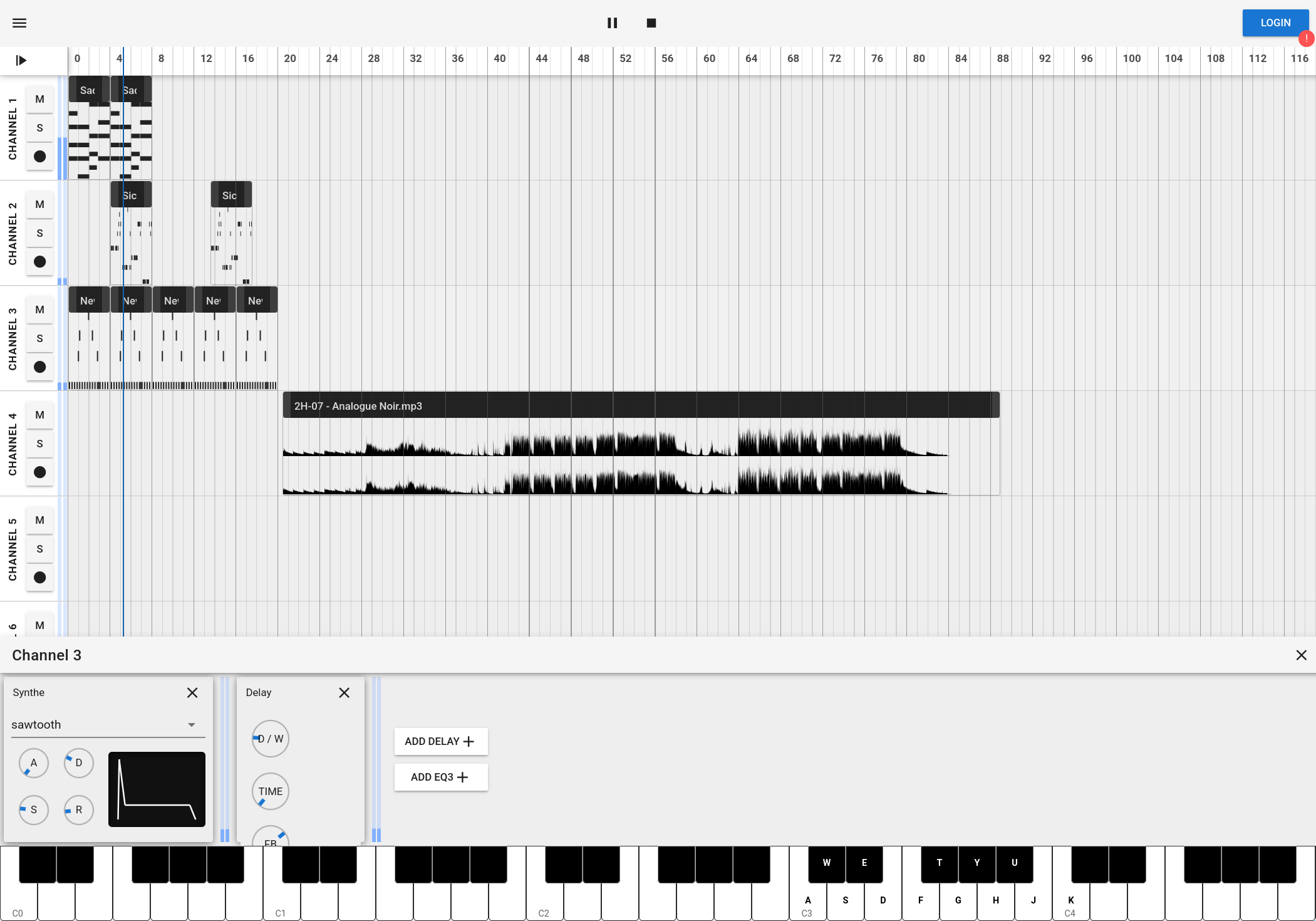
Unfortunately, life got in the way. At the same time I was finishing school, entering my career, and going through difficult times in my personal life, the project was running up against the inherent limitations of the technologies I had chosen. The arrangement view was not scaling up to larger projects, I was already hitting fundamental limitations of the Web Audio API, and the real-time mechanism I was using would never work for offline editing. The more I had learned about programming, the more amateur the prototype seemed, and it started to feel like a full re-write would be necessary to realize the dream I had started with. I got discouraged, and progress on Syne stalled for a few years.
A Fresh Start
One day during the COVID-19 pandemic, I randomly thought about syne.studio, and decided to go check on it. Imagine my shock when I saw that a bunch of people had recently signed up and tried using it! Global lockdowns highlighted the need I’d felt at college for remote musical collaboration, and in their search people had stumbled upon my humble prototype. It was quite a rush!
However, soon afterward the bug reports started flying in. People were excited about the idea, only to sign up and find that the app was buggy and limited. This reignited my passion for the project, and I decided I had to try again. By then I had been honing my skills as a professional programmer for a few years, and I knew I could do better a second time around.
I started over from scratch, being much more careful in the technologies I chose and making sure that each one would be able to take the project all the way. This process involved deep dives into hardware-accelerated graphics, SIMD DSP in the browser, decentralized computing, and more. I wanted to make sure that the next time I opened syne.studio up to the public, it would be ready to grow fast without needing to stop for any big rewrites.
Around this time I also reconnected with Evan after a long separation, and we ended up falling in love! After we moved in together, he was so excited by what he saw me working on that he decided to start contributing. His endless curiosity about DSP, and his much greater patience for advanced math than mine, are really pushing our audio engine to the next level.
The Future
After years of working and re-working syne.studio undercover, we think that we’ve finally acheived a meaningful proof of concept, and we’re ready to start showing the world what we’ve been working so hard on. Our dream is to be able to quit our jobs and work on syne.studio full-time. There’s still so much work needed to realize this idea to the fullest!
If you think syne.studio would be useful for you, or if you want it to be, you can support us by subscribing on patreon for $5 a month, which also unlocks full access and the ability to guid development during the closed beta. Or, subscribe for free if you just want to stay tuned for updates!
- Mel